 Skip to content



Anyone dealing with flat roofs will quickly encounter the term “parapet.” This component is located at the edge of a building’s roof and plays a crucial role in waterproofing, safety, and facade protection.
In modern flat roof construction, the parapet is one of the most important structural details. At the same time, the roof edge is one of the most sensitive areas of a building, as several technical systems converge here – waterproofing, insulation, drainage, and facade connection.
In this article, you will learn:
what a parapet is,
what functions it fulfills
, which standards apply
, and which errors commonly occur in parapet constructions.
What is an attic in flat roof construction?
An attic is a raised wall or parapet at the edge of a flat roof. It projects beyond the roof surface and forms the structural boundary between the roof and the facade.
Unlike pitched roofs with a visible overhang, the edge of flat roofs is often defined by an attic. This creates a clear building edge and a secure connection point for waterproofing.
Attics are typically used on:
flat roofs of residential buildings,
roof terraces,
office and commercial buildings,
and balconies or terraces.
In addition to its architectural effect, the attic fulfills several important technical functions.
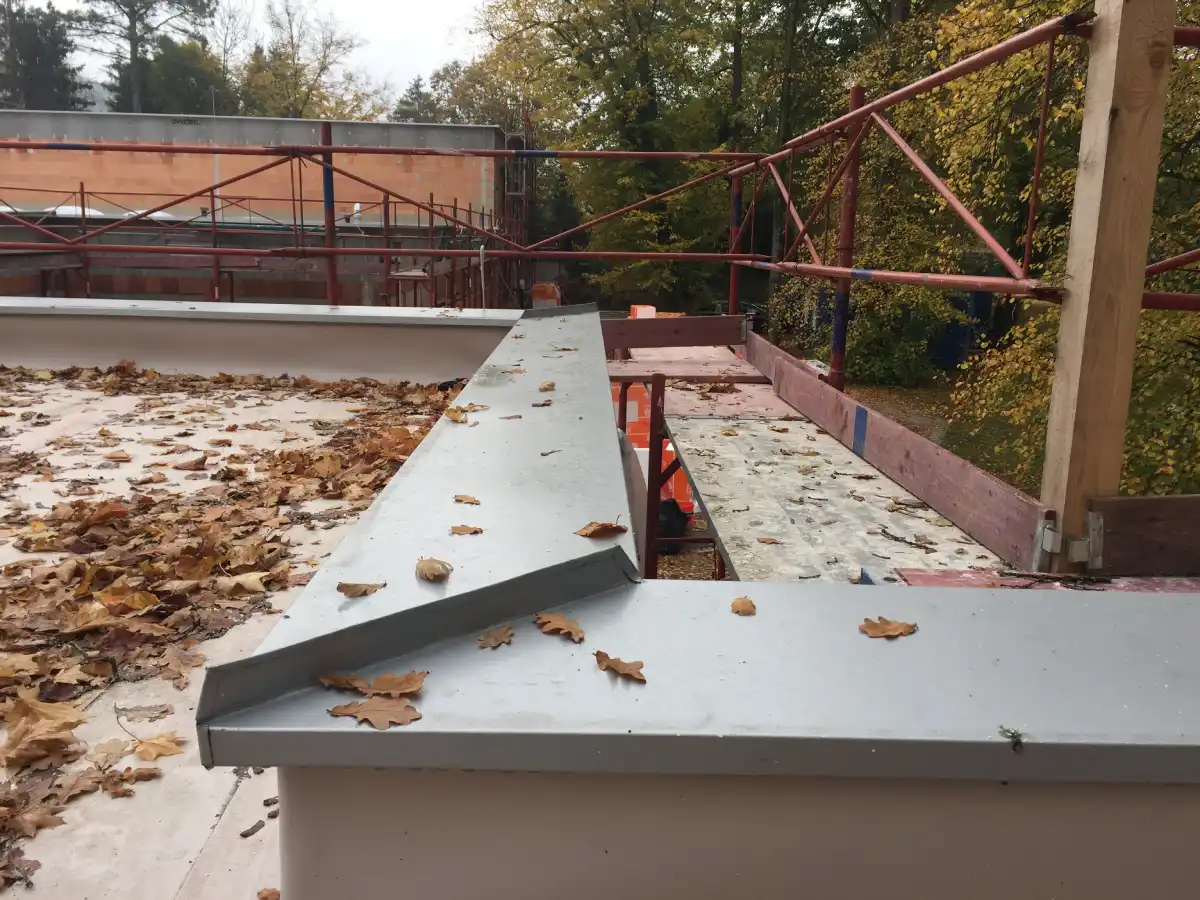
What functions does an attic parapet fulfill in flat roof construction?
The parapet fulfills several structural and building physics functions. It protects the roof structure, improves safety at the roof edge, and supports water drainage on the building.
Protection of the roof waterproofing
A key function of the parapet is to protect the roof waterproofing.
On flat roofs, the waterproofing is extended upwards along rising structural elements. This prevents rainwater from penetrating beneath the waterproofing.
Technical standards such as DIN 18531 or SIA 271 therefore require a sufficient waterproofing height at parapets and other rising structural elements.
Fall protection at the roof edge
Attics often also serve a safety function.
On roof terraces or accessible flat roofs, they act as fall protection and can replace or supplement a railing. This prevents people or objects from falling from the roof edge.
This function is particularly important in densely populated cities.
Protection of the facade from rainwater
Another advantage of the parapet is the protection it provides to the facade.
Parapet copings with drip edges ensure that rainwater is channeled away from the building in a controlled manner. This reduces damage to the facade surface, such as:
soiling
, frost damage,
and moisture penetration of the insulation.
Construction of an attic structure
An attic consists of several structural layers that must function together. The roof edge is therefore a complex detail involving various trades.
Typical components of an attic include:
load-bearing structure (e.g., concrete or masonry),
thermal insulation,
roof waterproofing,
attic coping made of metal or other materials,
and a drip edge for water drainage.
For these elements to function reliably over the long term, they must be precisely coordinated.
It is precisely at this interface that construction errors frequently occur in practice.
Standards and requirements for parapet constructions
Several technical regulations define requirements for flat roofs and parapet connections. These standards ensure that waterproofing, water drainage, and building physics function reliably over the long term.
DIN 18531 (Germany)
This standard regulates the waterproofing of roofs.
Important requirements include:
reliable water drainage at the roof edge,
sufficient waterproofing height,
and protection against water ingress behind the waterproofing.
SIA 271 (Switzerland)
The SIA 271 standard describes requirements for waterproofing of roofs, terraces and balconies.
Among other things, it requires:
standard-compliant connections to rising structural elements,
permanently functioning waterproofing details,
and reliable water drainage.
ÖNORM B 3691 (Austria)
This standard regulates the waterproofing of flat roofs in Austria.
The following points are particularly important here:
correct connection details,
durable waterproofing
, and reliable roof drainage.
Typical errors in parapet constructions
The roof edge is one of the most frequent sources of damage on flat roofs. This is because several components and materials meet here.
Typical defects include:
Inadequate sealing
If the waterproofing is not extended high enough, rainwater can penetrate behind the structure.
This leads to moisture damage in the building in the long term.
Thermal bridges at the roof edge
Massive attics made of concrete or masonry can act as significant thermal bridges.
This can lead to:
energy loss,
condensation, and
mold growth.
Faulty drip edges
If drip edges are missing or incorrectly sized, rainwater runs directly down the facade.
This results in soiling and long-term structural damage.
Modern parapet solution: Prefabricated parapet systems
Since the roof edge is a technically complex detail, modern construction projects are increasingly relying on prefabricated parapet systems.
These systems are industrially produced and offer several advantages over traditional cast-in-place concrete parapets.
These advantages include:
precise geometry,
standard-compliant connection details,
reduced thermal bridges,
and faster on-site assembly.
This significantly reduces planning and execution risks.
Related Service: Prefabricated parapet systems for the roof edge
Overtec develops prefabricated parapet systems specifically designed for modern flat roof edges.
These systems enable:
standards-compliant parapet constructions,
faster construction processes,
reduced thermal bridges,
and more sustainable building methods.
For more information, please visit Overtec.com or contact our team for technical advice and project support.
Conclusion
The parapet is a key component in flat roof construction. It protects the roof waterproofing, improves safety at the roof edge, and contributes to the protection of the facade.
Since several building components converge at the roof edge, the parapet is one of the most vulnerable points of a building. Careful planning and construction in accordance with standards are therefore crucial to prevent long-term damage.
Modern parapet systems now offer new possibilities for realizing roof edge details more safely, quickly, and sustainably.
FAQ – Attic in flat roof construction
An attic is a raised wall or parapet at the edge of a flat roof that extends beyond the roof surface and serves as a roof termination.
It protects the roof seal, serves as fall protection and helps to direct rainwater away from the building.
Not strictly necessary, but it is frequently used because it fulfills important functions for sealing and roof edge design.
Because several components converge here – sealing, insulation, metal connections and