Skip to content




Parapet wall flashing is one of the most critical yet misunderstood elements in flat roof construction.
While the roof surface often receives the most attention, failures rarely begin there—they almost always start at the edges.
A poorly executed parapet flashing detail can allow water to penetrate the building envelope, leading to hidden moisture damage that worsens over time.
In many projects, roof parapet leakage is not caused by material failure, but by incorrect detailing, poor coordination between trades, and lack of system integration at the roof edge.
Why Parapet Wall Flashing Is Critical in Flat Roof Waterproofing Systems
The junction between the horizontal roof surface and the vertical parapet wall is one of the most vulnerable points in a building.
This transition zone is exposed to water accumulation, wind-driven rain, and thermal movement, making it a high-risk area for leakage.
Water Behavior at the Roof Edge and Parapet Junction
Water does not simply flow off a roof—it moves unpredictably due to wind pressure, surface tension, and capillary action.
At the parapet wall, water can:
- accumulate near the edge
- be pushed upward by wind
- travel beneath flashing elements
Without proper flashing, water finds its way into the system.
Multi-Layer Complexity of Parapet Waterproofing
A parapet waterproofing detail typically includes multiple layers:
- structural wall
- insulation
- waterproof membrane
- flashing
- coping or cap
If even one layer is incorrectly installed, the entire system becomes vulnerable.

Common Parapet Wall Waterproofing Problems and Leakage Causes
Most parapet wall waterproofing problems arise from predictable and preventable issues.
These failures often develop slowly, making them difficult to detect until significant damage occurs.
Inadequate Parapet Flashing Detail
One of the most common causes of failure is an incomplete or poorly designed flashing detail.
If flashing is not properly integrated with the waterproof membrane, water can bypass the protective layers and enter the structure.
Roof Parapet Leakage Due to Poor Height and Overlaps
Flashing must extend high enough above the finished roof surface.
If this height is insufficient, water can flow over the flashing and into the wall assembly.
Incorrect overlaps between materials also allow water ingress.
Material Incompatibility and Thermal Movement
Different materials expand and contract at different rates.
When metal flashing meets bitumen or synthetic membranes without proper separation, stress points form.
Over time, this leads to cracks, detachment, and leakage.
Flat Roof Parapet Flashing Detail: Key Design Principles
A correct flat roof parapet flashing system is not a single component—it is a coordinated assembly.
Every layer must work together to ensure water is directed away from the structure.
Continuous Waterproofing Integration
The waterproof membrane must be seamlessly connected to the flashing system.
This continuity ensures that water cannot bypass protective layers.
Disruptions in this connection are one of the most common failure points.
Proper Height and Termination of Flashing
Flashing should extend sufficiently above the roof surface to prevent overtopping.
Termination points must be secured and protected to avoid peeling or displacement due to wind or thermal stress.
Controlled Water Discharge at the Roof Edge
Water must be directed away from the façade using defined edges and drip details.
Without proper edge control, water can run down the façade, causing staining and long-term damage.

Role of Parapet Cap Flashing in Roof Edge Protection
The parapet cap flashing serves as the final protective layer at the top of the parapet wall.
It shields the underlying structure from direct exposure to rain, UV radiation, and temperature fluctuations.
Protection Against Water Penetration from Above
While most focus is on horizontal waterproofing, water can also enter from the top of the parapet.
Cap flashing prevents this by sealing the upper surface and directing water outward.
Importance of Drip Edges and Overhangs
A properly designed cap includes a drip edge that ensures water detaches cleanly from the surface.
Without this detail, water can run back toward the wall and undermine the system.
Roof Edge Waterproofing Systems: From Traditional to Modern Solutions
Traditional parapet construction relies heavily on on-site execution, which introduces variability and risk.
Modern systems aim to reduce these risks through precision and integration.
Limitations of Traditional Site-Built Flashing Systems
On-site fabrication often leads to inconsistencies in geometry, alignment, and sealing.
These variations make it difficult to achieve consistent waterproofing performance.
Advantages of Prefabricated Parapet Systems
Prefabricated systems are designed with integrated flashing geometry and controlled dimensions.
This reduces the likelihood of installation errors and ensures repeatable quality across projects.
Related Solution: Overtec Parapet Systems for Reliable Roof Edge Waterproofing
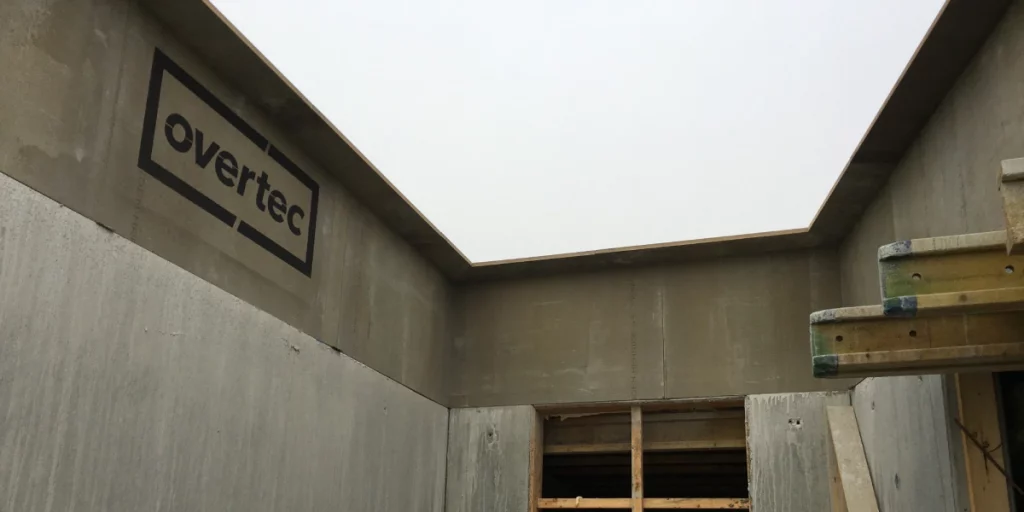
Overtec offers prefabricated parapet systems that address common flashing and waterproofing challenges at the roof edge.
These systems are engineered to simplify detailing and improve construction accuracy.
How Overtec Systems Improve Parapet Waterproofing
The systems provide:
- precise geometry for flashing integration
- consistent parapet height and alignment
- reduced reliance on on-site adjustments
This minimizes the risk of leakage and improves long-term durability.
Why Architects and Builders Choose Prefabricated Solutions
Prefabrication allows for better planning, faster installation, and reduced construction uncertainty.
It also aligns with modern requirements for sustainability and efficiency in building design.
Learn more at overtec.com
Conclusion
Parapet wall flashing is not a minor construction detail—it is a critical component of the building envelope.
Failures at this junction can lead to severe structural and aesthetic damage, often requiring costly repairs.
By understanding proper flashing principles and adopting integrated systems, it is possible to eliminate common leakage risks and create durable, high-performance roof edges.
FAQ – Parapet Wall Flashing
Parapet wall flashing is a waterproofing detail that seals the junction between the roof surface and the parapet wall to prevent water ingress.
Leakage usually occurs due to poor flashing design, insufficient height, or improper integration with the waterproof membrane.
It protects the top of the parapet wall from water penetration and directs water away from the structure.
Yes, because they ensure consistent geometry, reduce installation errors, and improve overall system reliability.