Skip to content




Choosing between precast vs cast in place concrete is not simply a choice between two ways of using concrete. It is a decision about how a building is designed, manufactured, scheduled, transported, installed and maintained.
With cast in place concrete, reinforcement, formwork and concrete are assembled at the project site. The concrete is poured into its final position and develops strength there. With precast construction, concrete components are manufactured away from the building, cured and inspected, then transported to the site for installation.
Both methods are proven construction systems. Neither is automatically better.
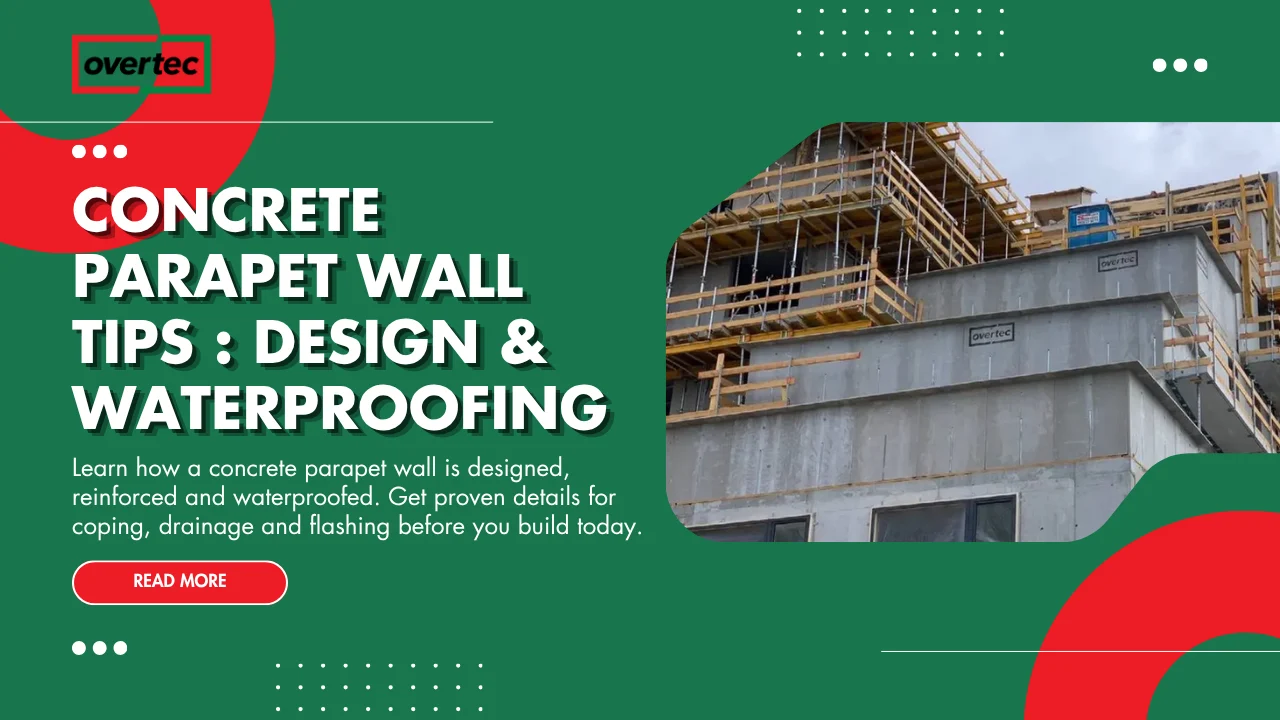
Precast can provide faster installation, controlled factory production, repeatability and reduced site wet work. For projects involving roof edges, balconies or terraces, precast concrete parapet systems are another consideration when evaluating prefabricated construction solutions. Cast-in-place concrete can provide greater flexibility, fewer transportation constraints and easier adaptation to irregular site conditions.
The correct decision depends on building geometry, repetition, access, structural requirements, labour availability, construction sequence, transportation, crane capacity and overall construction costs.
This guide compares the two methods from an architect’s, engineer’s and contractor’s perspective, including quality control, concrete curing, installation time, environmental considerations, common mistakes and situations where each system makes the most sense.
Quick Answer : Precast vs Cast in Place
| Topic | Precast Concrete | Cast in Place Concrete |
| Basic method | Concrete elements manufactured off-site | Concrete poured directly into final position |
| Production | Factory or controlled facility | Construction site |
| Formwork | Reusable moulds often used | Site-specific formwork |
| Quality control | Highly controlled manufacturing environment | Dependent on site conditions |
| Installation time | Often faster for repetitive components | Usually more sequential |
| Transportation | Finished elements must be transported | Raw materials transported |
| Crane requirement | Often significant | Depends on application |
| Design flexibility | Lower after production begins | Generally higher during construction |
| Weather exposure | Lower during manufacturing | Higher during site casting |
| Best for | Repetitive, coordinated projects | Flexible or irregular projects |
| Main risk | Logistics and connection coordination | Site productivity and environmental conditions |
| Cost | Can benefit from repetition | Can benefit from flexibility and local production |
What Is the Difference Between Precast and Cast-in-Place Concrete?
The fundamental difference is where the concrete component is produced.
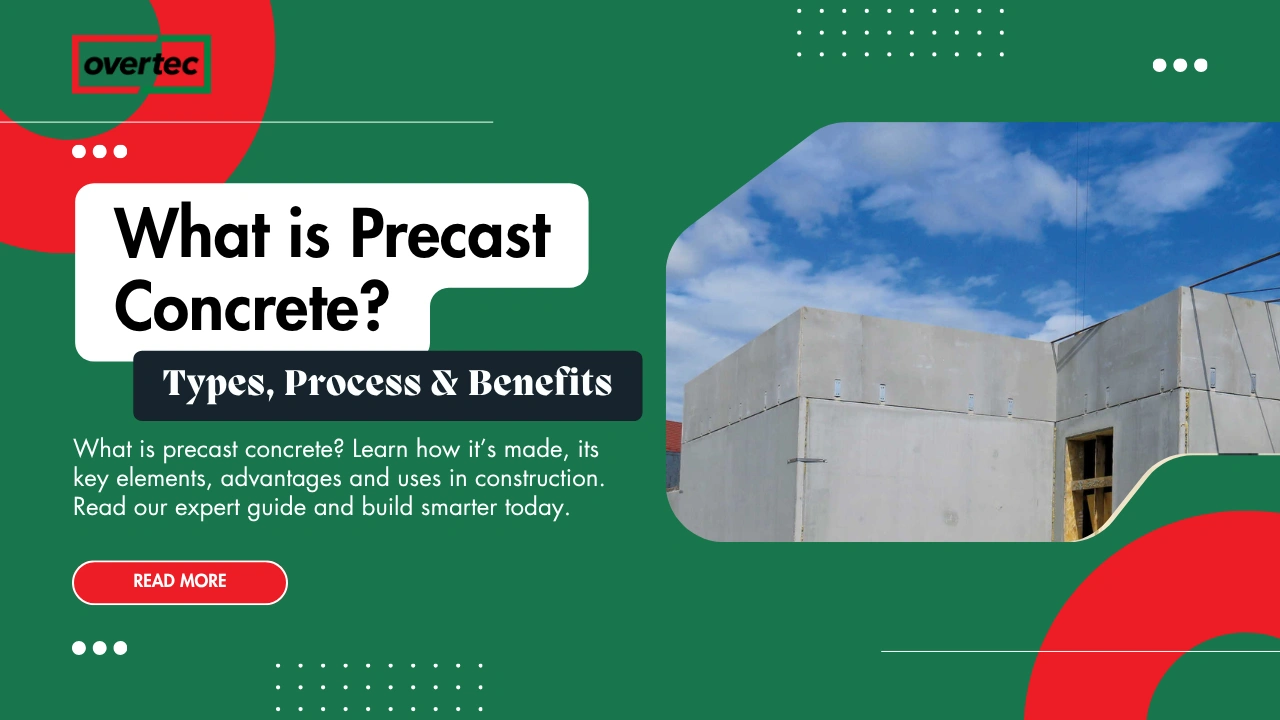
Precast concrete is manufactured before it reaches its final location. A Precast concrete wall panel, beam, column or stair can be produced in a factory, cured, inspected and delivered to the project as a finished component.
Cast-in-place concrete is produced directly at the project location. Formwork is installed, reinforcement is positioned, concrete is placed and the element remains in position while the concrete gains strength.
This difference creates a series of secondary effects. Precast moves more work into manufacturing and logistics, while cast-in-place construction keeps more work at the building site.
| Construction Stage | Precast | Cast in Place |
| Form preparation | Factory mould | Site formwork |
| Reinforcement | Factory-controlled setup | Site installation |
| Concrete placement | Production facility | Site |
| Curing | Controlled production environment | Site conditions |
| Quality inspection | Before delivery and installation | Primarily during site construction |
| Transportation | Finished element | Materials |
| Final positioning | Crane/lifting and connections | Already in final position |
| Site modification | More difficult | Generally easier |
How Does the Construction Process Differ?
The construction process for precast starts much earlier than the visible installation. Production drawings, panel dimensions, reinforcement, connection details, lifting points and transportation requirements must be coordinated before manufacturing.
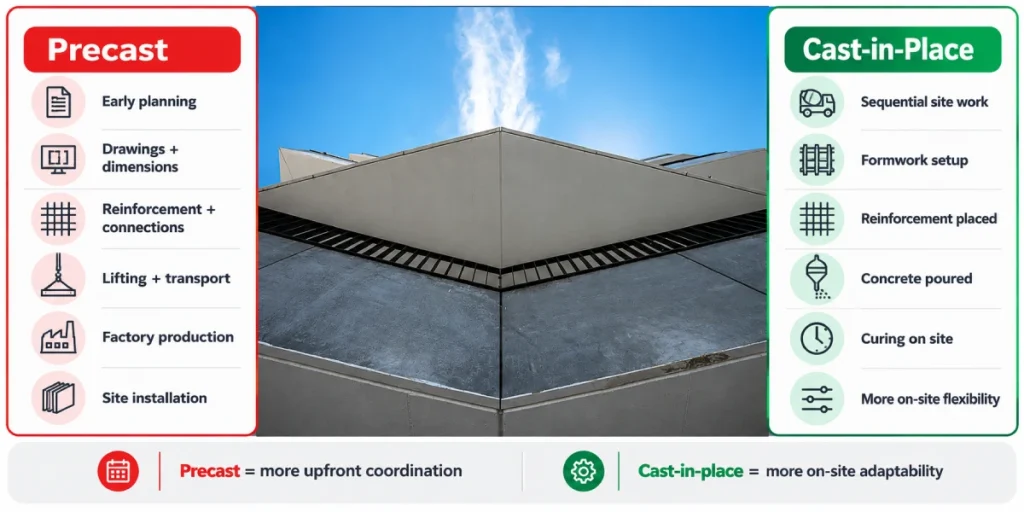
Once the components are produced, the site team prepares the supporting structure and installation sequence. Panels or other elements are delivered according to the programme and lifted into their final position.
With cast in place concrete, much of the work happens sequentially on site. Formwork is erected, reinforcement is installed, concrete is poured and the element remains in place during concrete curing.
This makes the two systems fundamentally different from a project-management perspective. Precast requires more preparation before production, while cast-in-place work can retain greater adaptability during construction.
Precast Concrete Construction
Precast construction moves repetitive concrete production away from the project site.
A factory can use reusable moulds, controlled reinforcement processes and defined concrete production procedures. Multiple similar components can be manufactured in batches rather than reconstructed individually at different locations around the building.
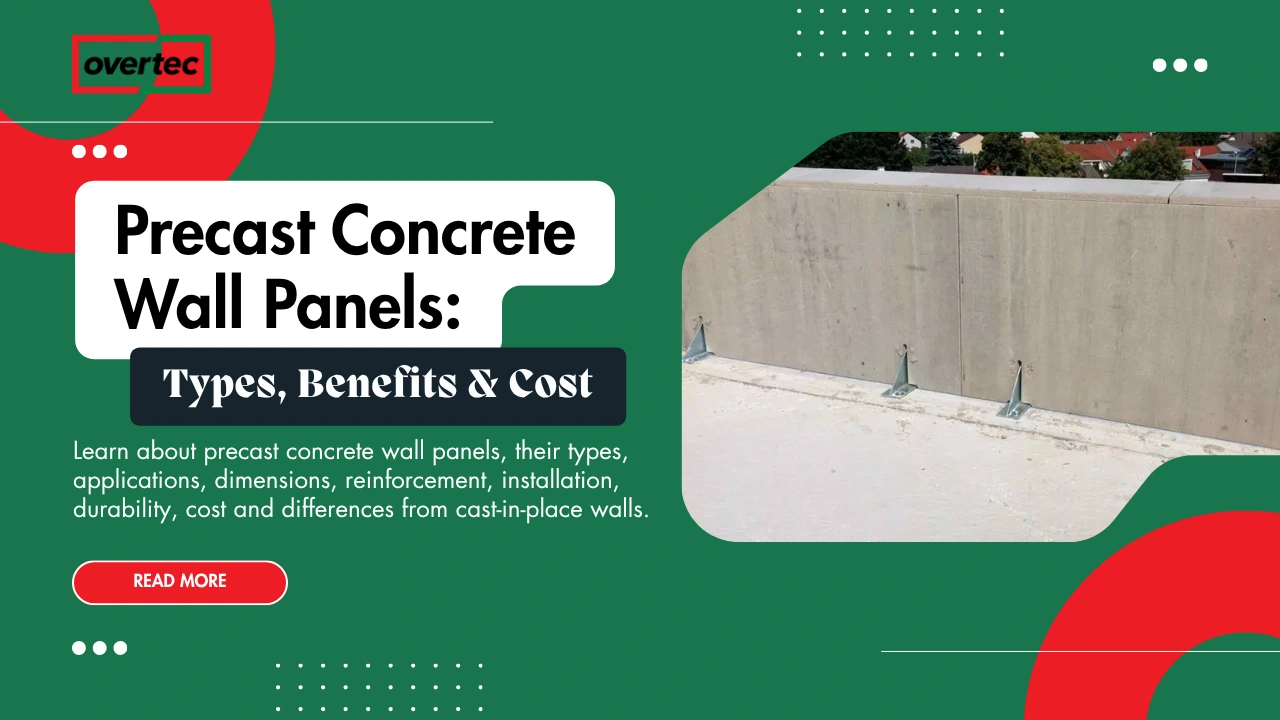
This is particularly useful for projects with repetitive geometry. Apartment buildings, parking structures, industrial buildings and commercial façades can contain hundreds of similar components. For projects that use wall elements, understanding the design and application of precast concrete walls can help clarify how precast components fit into the overall construction process.
The disadvantage is that the design needs to be coordinated earlier. Once an element has been manufactured, changing a window opening, connection position or overall dimension is considerably more difficult than changing a site-built formwork arrangement.
| Precast Characteristic | Project Effect |
| Factory production | Controlled manufacturing environment |
| Reusable moulds | Efficient repetitive production |
| Early design freeze | Better production planning |
| Finished elements | Faster site installation |
| Transportation | Additional logistics requirement |
| Crane installation | Faster placement but requires lifting planning |
| Factory inspection | Earlier defect detection |
| Standardisation | Higher efficiency for repetitive designs |
Cast in Place Concrete Construction
Cast in place concrete keeps manufacturing at the project location. This is a major advantage when the building contains irregular geometry, changing dimensions or difficult-to-transport components.
Formwork can be adapted to the actual site and structural conditions. Openings and penetrations can often be adjusted before concrete placement, and some modifications remain possible during construction.
The method does, however, expose production to site conditions. Temperature, rain, access, labour availability, formwork quality and concrete placement conditions can all affect productivity and quality.
For many buildings, cast-in-place construction remains the logical solution because the project does not contain enough repetition to justify factory production or because the site geometry makes prefabrication impractical.
Quality Control: Precast vs Cast in Place
Quality control is one of the strongest arguments for precast construction. A production facility can establish controlled procedures for mould preparation, reinforcement, concrete batching, compaction, curing and dimensional inspection.
This does not mean every precast component is automatically higher quality. The factory must still have appropriate production controls, trained personnel and inspection procedures.
Cast-in-place quality depends more directly on the conditions at the construction site. Formwork alignment, reinforcement placement, concrete placement, vibration, curing and protection must all be managed in changing environmental conditions.
The practical difference is therefore control and repeatability, rather than an inherent difference in concrete quality.
| Quality Factor | Precast | Cast in Place |
| Mould accuracy | Controlled factory environment | Site dependent |
| Reinforcement placement | Repeatable production process | Site workmanship |
| Concrete batching | Controlled facility | Site/project supply chain |
| Curing | More controlled | Weather dependent |
| Dimensional inspection | Before delivery | During construction |
| Repetition | Highly consistent | Depends on repeated site work |
| Defect correction | Can occur before delivery | Often occurs during/after site work |
Which Method Is Faster?
There is no universal answer, but precast often has an advantage when a project contains many repetitive elements.
The main reason is parallel production. Wall panels, stairs or other components can be manufactured while foundations or other site activities continue. Once delivered, installation can be considerably faster than constructing the same element from formwork and wet concrete at the final location.
Cast-in-place construction has fewer logistics steps. There is no need to transport finished panels or coordinate a crane for every element. On a small project, this simplicity can outweigh the theoretical speed advantage of prefabrication.
The relevant measurement is therefore total project installation time, not simply how quickly concrete can be poured.
| Situation | Likely Advantage |
| Large repetitive project | Precast |
| Small one-off structure | Cast in place |
| Highly repetitive walls | Precast |
| Irregular geometry | Cast in place |
| Restricted crane access | Potentially cast in place |
| Long manufacturing lead time | Potentially cast in place |
| Tight enclosure programme | Often precast |
| Many simultaneous site activities | Often precast |
Design Flexibility and Site Conditions
Cast-in-place construction generally provides greater flexibility because the concrete is created directly where it is required.
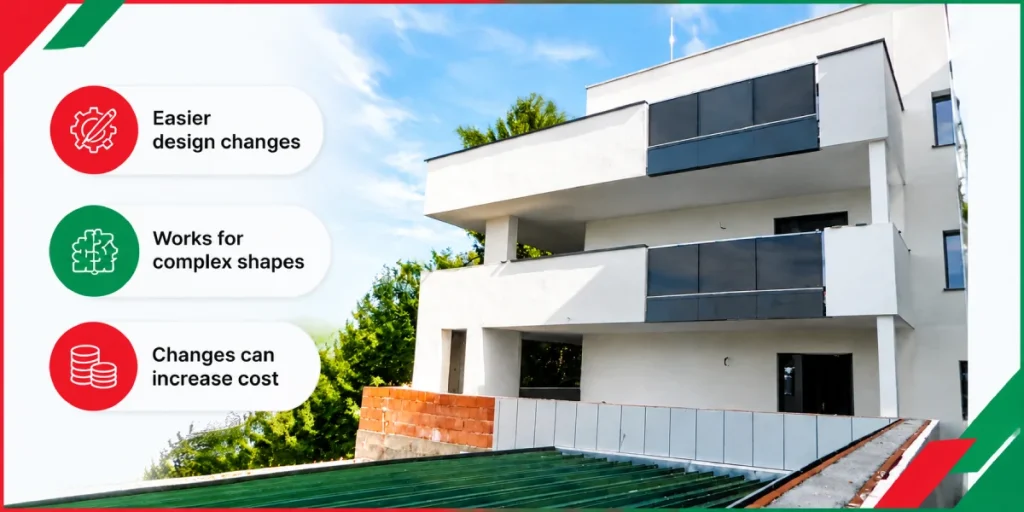
If a site dimension changes or an opening needs adjustment, the formwork can often be modified before the concrete is poured. This flexibility is particularly valuable in renovation, complex geometries and projects where design information continues to develop during construction.
Precast requires greater discipline. Panel dimensions, connections, lifting points and openings must be coordinated before production. Changes after manufacturing can create significant additional cost.
For this reason, the complexity of the site conditions should be considered before selecting a system. A highly accessible, repetitive building may suit precast very well, while a constrained or irregular site may favour cast in place.
Transportation and Installation
Transportation is one of the most important differences in the precast vs cast in place decision.
With precast, the project must move finished concrete elements from the factory to the site. Panel dimensions and weight therefore have to comply with available transport routes, vehicle capacity and local restrictions.
Installation also requires suitable lifting equipment. Large panels may need cranes with sufficient capacity and reach, while the site needs adequate space for positioning and temporary storage.
Cast-in-place construction transports concrete ingredients or ready-mixed concrete rather than finished structural components. This reduces finished-element logistics but increases the amount of work performed at the project location.
Construction Costs : Precast vs Cast in Place
Comparing construction costs requires more than comparing the price of concrete per cubic metre. Precast includes manufacturing, moulds, reinforcement, factory quality control, transportation, lifting and connection costs. Cast-in-place construction includes formwork, reinforcement, concrete placement, curing, labour and site management.
Precast becomes increasingly attractive when the project contains a large number of identical or similar components. The initial mould and production setup can then be distributed across many units.
Cast-in-place concrete can be more economical where quantities are small, geometry is irregular or transportation and crane costs would be disproportionate. Local material availability and labour rates can also change the result considerably.
The correct comparison should therefore use the total installed cost, not just the factory price of the concrete component.
| Cost Factor | Precast | Cast in Place |
| Concrete | Factory-produced | Delivered to site |
| Formwork | Reusable production moulds | Site-built formwork |
| Labour | More factory, less site work | More site labour |
| Transportation | Finished elements | Raw materials |
| Crane | Often required | Project dependent |
| Site storage | May be required | Generally lower |
| Design changes | Potentially expensive | Usually easier |
| Repetition | Strong economic advantage | Less significant |
| Small quantities | May be less competitive | Often advantageous |
Which Method Provides Better Project Efficiency?
Project efficiency depends on the complete sequence rather than one individual construction activity.
Precast can improve efficiency by allowing factory production and site preparation to occur simultaneously. Finished components can also reduce the amount of formwork and wet work required at the project location.
Cast-in-place construction can be highly efficient when the site is well organised and the structure has simple geometry. It avoids the transportation and lifting operations associated with finished precast components.
The best system is therefore the one that removes the greatest bottleneck from the specific project. A congested urban site may benefit from rapid installation, while a remote project with difficult transport access may favour on-site casting.
Weather and Site Conditions
Weather affects both systems differently. Precast production takes place in a controlled environment, reducing the effect of rain, temperature and other site conditions during manufacturing.
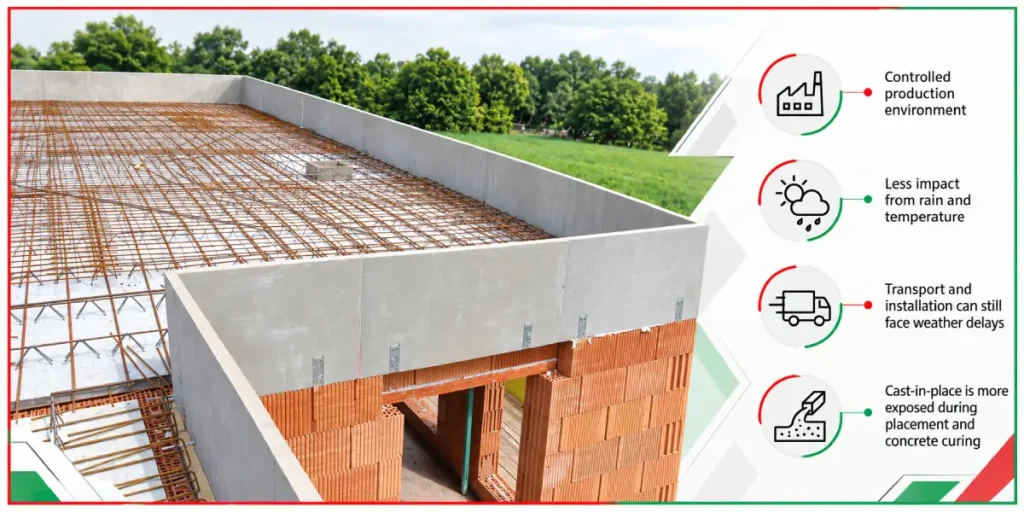
The finished element still has to be transported and installed at the project site, so precast does not completely eliminate weather-related delays. Crane operations, access and connection work can still be affected.
Cast-in-place construction has greater exposure during formwork, concrete placement and concrete curing. Temperature, precipitation and site protection can influence the construction sequence and quality.
This difference can be valuable in projects with tight programmes or challenging climates, but it should be evaluated alongside the project’s actual installation conditions.
Environmental and Lifecycle Considerations
Neither system is automatically the more sustainable option. The environmental impact depends on concrete quantity, cement content, reinforcement, factory energy, transportation distance, site waste and the eventual service life of the component.
Precast can reduce material waste through controlled production and reusable moulds. It can also reduce certain site activities and enable efficient manufacturing of repetitive components.
Cast-in-place construction may have a logistics advantage when the project is close to concrete suppliers and finished components would otherwise require long-distance transportation.
Lifecycle performance is equally important. A durable wall that requires fewer repairs can provide a better overall result regardless of whether it was manufactured in a factory or cast on site.
| Lifecycle Factor | Precast | Cast in Place |
| Factory waste control | Strong potential | Not applicable |
| Site waste | Potentially lower | Can be higher |
| Transportation | Finished components | Raw materials |
| Reusable moulds | Strong advantage | Site formwork may be reused |
| Durability | Design dependent | Design dependent |
| Repairability | Connection-dependent | Generally flexible |
| Environmental result | Project specific | Project specific |
Real Construction Examples
Every project needs a different concrete method. These real construction examples show how repetition, logistics, and design changes affect the choice between precast and cast-in-place.
Residential Apartment Building
Consider a 10-storey apartment building with repetitive floor plans and approximately 200 similar wall components.
Precast can be attractive because the same moulds and reinforcement details can be repeated. Wall production can continue while foundations and the structural frame progress.
A cast-in-place solution would require substantial repeated formwork and site labour. However, if the apartment layouts vary significantly between floors, the economic advantage of precast may decrease.
Commercial Office Building
A commercial building with a regular structural grid and a tight enclosure programme may benefit from precast façade and wall elements.
Panels can be manufactured while the structural frame is progressing and then installed floor by floor. This can allow the building envelope to close earlier, supporting subsequent interior trades.
Cast-in-place construction may still be preferable for irregular structural cores or locations where connection complexity makes prefabrication inefficient.
Small Industrial Extension
Consider a small industrial extension with only a few walls and irregular service openings.
Cast-in-place construction may be more practical because the project does not have enough repetition to justify specialised precast production. Transport and crane mobilisation could also represent a significant proportion of the total cost.
This illustrates an important principle: precast is not automatically better for larger or smaller projects; repetition and logistics often matter more than floor area alone.
Common Mistakes When Choosing Between the Systems
The most common mistake is making the decision based only on material price. A low component price does not necessarily mean a low installed project cost.
Another mistake is selecting precast too late. If production drawings, transport planning and connections are not resolved early, the project can lose the schedule advantage that made prefabrication attractive.
Conversely, choosing cast-in-place simply because it appears flexible can overlook the cost of repetitive formwork and prolonged site labour.
| Mistake | Consequence | Better Decision Process |
| Compare concrete prices only | Misleading cost comparison | Compare total installed cost |
| Select precast late | Manufacturing delays | Plan production early |
| Ignore transportation | Unexpected logistics cost | Review route and dimensions |
| Ignore crane requirements | Installation delays | Check lifting strategy |
| Over-standardise irregular work | Unnecessary complexity | Use cast-in-place where flexibility matters |
| Ignore repetition | Lost factory efficiency | Assess component quantities |
| Ignore lifecycle | Short-term decision | Compare maintenance and durability |
Traditional vs Prefabricated Concrete
Is prefabricated concrete better than cast-in-place concrete? It depends on your project. See how both methods compare on repetition, crane needs, and design changes.
| Factor | Cast in Place | Prefabricated/Precast |
| Manufacturing location | Site | Factory |
| Quality control | Site dependent | Controlled production |
| Installation time | Generally longer for repetitive elements | Often shorter |
| Labour distribution | More site labour | More factory labour |
| Design flexibility | High | Lower after production |
| Weather exposure | Higher | Lower during manufacturing |
| Transportation | Lower finished-element logistics | Higher |
| Crane dependence | Variable | Often higher |
| Repetition | Less efficient in some cases | Highly efficient |
| Site modification | Easier | More difficult |
| Best use | Irregular/flexible construction | Repetitive/coordinated construction |
Decision Checklist
Precast or cast-in-place concrete: which fits your project? This checklist helps you decide based on repetition, design changes, site access, and construction time.
When Precast Is Often the Better Choice
Precast is worth serious consideration when the building contains many repeated walls, panels, beams or other elements.
It is also attractive when site labour, wet work or construction time are major constraints and when there is sufficient access for delivery and lifting.
The project should ideally have a reasonably stable design before manufacturing begins.
| Condition | Precast Suitability |
| High repetition | High |
| Tight installation programme | High |
| Controlled factory production desired | High |
| Good crane access | High |
| Stable design | High |
| Difficult transport access | Lower |
| Frequent design changes | Lower |
| Highly irregular geometry | Lower |
When Cast in Place Is Often the Better Choice
Cast-in-place concrete can be advantageous when the geometry is irregular, quantities are relatively small or the project requires substantial flexibility during construction.
It can also be preferable where transportation of large components is difficult or crane access is severely restricted.
The method remains highly capable for large projects, particularly where formwork systems and concrete supply are well organised.
Standards, Codes and Safety
The applicable requirements depend on the project’s location and structural system. European projects may use relevant EN and DIN standards together with Eurocodes, while U.S. projects may be governed by the IBC and associated standards.
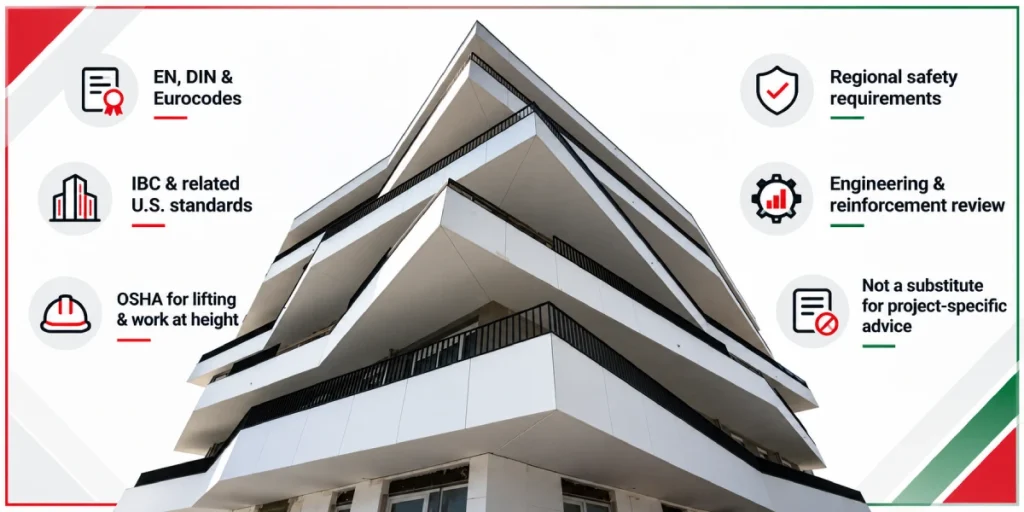
Safety requirements also differ by jurisdiction. OSHA requirements may apply to U.S. projects for activities such as lifting and work at height. European projects follow the applicable national and regional occupational-safety requirements.
Regardless of the construction method, structural calculations, reinforcement design, concrete specifications, fire requirements and temporary construction conditions must be addressed by the responsible project professionals. This article is educational and is not a substitute for project-specific engineering or regulatory advice.
Overtec and the Prefabricated Construction Approach
The comparison between precast and cast-in-place construction also illustrates the broader principle behind modern prefabrication: move repetitive, quality-sensitive work into a controlled production environment where this improves the overall project.
For suitable Overtec applications, factory production can provide faster installation, reduced site labour and reduced dependence on skilled labour at the installation stage. Factory precision can improve consistency and make the construction sequence more predictable.
Overtec states potential reductions of up to 67% in CO₂ emissions compared with the relevant conventional construction approach. The system is also intended to support better waterproofing integration, reduced thermal bridging and lower weather dependency during manufacturing.
Where applicable, a slim profile can create more usable balcony or terrace space. For projects involving balcony and terrace edges, prefabricated parapet wall systems can be relevant to understanding how factory-made wall components support efficient installation. Combined with factory precision, reduced site work and predictable installation, these characteristics can lower construction risk and improve lifecycle performance.
The appropriate comparison should still be project-specific. Prefabrication creates the greatest value when the design, logistics, interfaces and installation sequence are coordinated from the beginning.
FAQs About Precast vs Cast in Place Concrete
Not sure whether to choose precast or cast-in-place concrete? Here are quick, easy answers on when to use each method, from repetitive buildings to irregular designs.
Precast concrete is manufactured away from its final location and installed later. Cast-in-place concrete is poured and cured directly in its final position.
Neither method is universally better. Precast is often advantageous for repetitive, coordinated projects, while cast-in-place can be better for irregular or highly flexible construction.
Major advantages include controlled factory production, repeatability, reduced site wet work and potentially faster installation.
It provides greater flexibility, avoids finished-element transportation and can adapt more easily to irregular site conditions.
Precast is often faster for repetitive components because manufacturing and site preparation can happen in parallel. The actual advantage depends on logistics and production lead time.
It depends on quantity, repetition, labour, transport, crane requirements, formwork and project conditions. Total installed cost should be compared.
Precast generally provides greater manufacturing control because production occurs in a controlled environment. Cast-in-place quality depends more directly on site execution.
It is particularly suitable for repetitive components, tight installation programmes and projects where factory-controlled production provides a clear advantage.
Not inherently. Strength depends on concrete specification, reinforcement, design, curing and quality control.
Large precast components normally require suitable lifting equipment. Smaller elements may use other installation methods.
Cast-in-place construction often provides greater flexibility for highly irregular geometry and frequent changes.
Neither is automatically more sustainable. The result depends on materials, production, transport, waste, energy use and lifecycle performance.
Conclusion
The decision between precast vs cast in place concrete should be based on the entire construction system rather than the price of concrete alone.
Precast shifts manufacturing into a controlled environment and can provide faster installation, repeatability, reduced site labour and better production consistency. Its disadvantages are the need for earlier coordination, transportation, lifting and carefully engineered connections.
Cast-in-place concrete remains one of the most flexible construction methods available. It works particularly well where geometry is irregular, quantities are limited, site access is straightforward or design changes are expected during construction.
For repetitive buildings with stable designs and suitable logistics, precast construction can deliver substantial project efficiency. For complex, variable or highly site-specific work, cast-in-place construction may provide the better overall solution.
The strongest project strategy is not to ask which method is universally superior. It is to ask which method produces the safest, most predictable and cost-effective building for the specific project conditions.