Skip to content



An environmental product declaration (EPD) is becoming an increasingly important source of environmental information for architects, engineers, developers, contractors and construction-product manufacturers.
As the construction industry focuses more strongly on embodied carbon, material efficiency and whole-life environmental performance, simply describing a product as “sustainable” is no longer enough. Design teams increasingly need measurable information that can be incorporated into building assessments and compared against project targets.
This is where an EPD becomes useful.
An environmental product declaration provides structured environmental information about a product based on Life Cycle Assessment (LCA) and defined calculation and reporting rules. For construction products, EPDs can provide information about environmental impacts associated with manufacturing and other defined life-cycle stages.
However, an EPD is not simply a green certificate. It does not automatically mean that a product is environmentally better than another product. The declaration provides quantified information that must be interpreted within its declared scope, product category rules, reference unit and life-cycle boundaries.
This guide explains what an environmental product declaration is, how EPDs work, what information they contain, how to read them, how they relate to LCA and embodied carbon, and how they can support sustainable construction decisions.
Quick Answer: What Is an Environmental Product Declaration?
| Topic | Quick Answer |
| What is an environmental product declaration? | A standardized declaration communicating quantified environmental information about a product based on life-cycle assessment. |
| What does EPD stand for? | Environmental Product Declaration. |
| Is an EPD the same as an LCA? | No. LCA is the assessment methodology; an EPD communicates defined environmental results in a standardized format. |
| Which standards are relevant? | ISO 14025 and, for construction products, EN 15804 are important reference standards. |
| What does an EPD measure? | Multiple environmental impact categories, including Global Warming Potential and other indicators depending on the applicable rules. |
| What is embodied carbon? | The greenhouse-gas impact associated with materials and construction-related processes over a defined scope. |
| Is an EPD a sustainability certificate? | Not in the conventional sense. It reports environmental performance rather than simply awarding a sustainability rating. |
| Is an EPD mandatory? | Requirements depend on regulations, procurement conditions, market requirements and individual building projects. |
| What is a declared unit? | The reference quantity against which environmental results are reported. |
| Can EPDs be compared? | Yes, but only carefully. Products, units, PCR, system boundaries and life-cycle stages must be sufficiently comparable. |
What Is an Environmental Product Declaration?
An environmental product declaration is a structured document that communicates quantified environmental information about a specific product or defined product group.
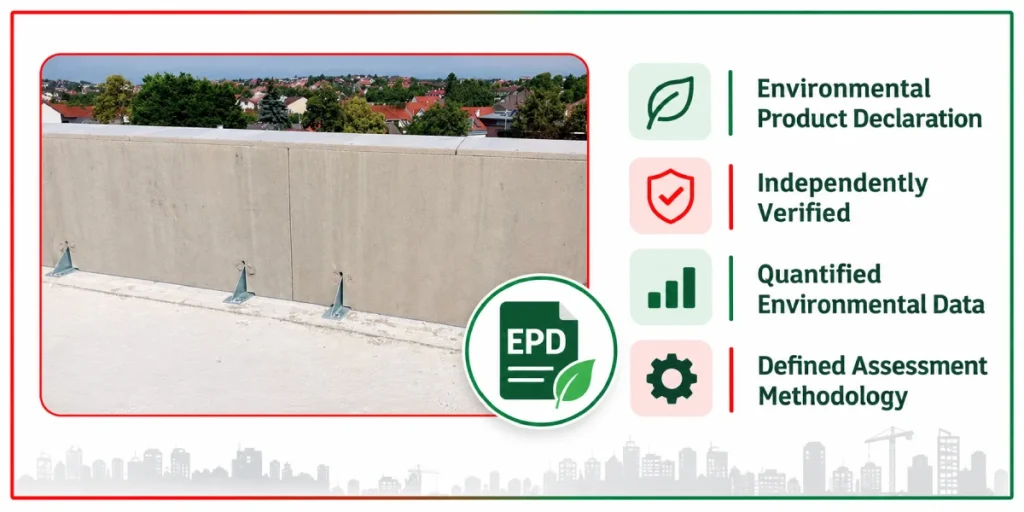
The declaration is based on a defined methodology rather than a manufacturer’s general sustainability statement. This distinction is important because environmental claims without a transparent calculation basis are difficult for an architect or engineer to incorporate into a building assessment.
An EPD can therefore be thought of as an environmental information sheet with a much more rigorous methodological foundation. It describes the product, the assessment approach, relevant assumptions and environmental indicators generated through the assessment.
For construction products, this information can become an input into broader building-level calculations.
Environmental Product Declaration Definition
A practical environmental product declaration definition is:
An independently verified environmental declaration that communicates quantified environmental information for a product according to defined assessment, calculation and reporting rules.
The exact content depends on the relevant EPD programme, product category and applicable rules.
This means that an EPD should always be read together with its methodological information. The numerical result alone is not enough.
For example, a GWP value reported per kilogram of material and another value reported per square metre of installed product are not automatically comparable. The reference basis must first be understood.
Why Are Environmental Product Declarations Important?
The environmental impact of a building is not determined only by its operational energy use. Materials, manufacturing processes, transportation, construction activities, maintenance and end-of-life treatment can all contribute to the overall environmental footprint.
This is particularly important for structural and building-envelope products because large quantities of materials can be incorporated into a building for decades.
An EPD gives the project team a way to move from broad environmental claims toward quantified product information. Instead of asking only whether concrete, steel, timber or another material is “green,” the design team can examine environmental indicators within a defined assessment framework.
The information can then be used alongside structural performance, fire resistance, durability, thermal performance, cost and constructability.
EPDs and Embodied Carbon
Embodied carbon is one of the major reasons EPDs have become increasingly relevant in construction.
A product’s embodied environmental impact can arise from raw-material extraction, processing, manufacturing, transportation, construction and other defined life-cycle processes. For many construction products, manufacturing can be a significant contributor.
The Global Warming Potential (GWP) indicator is therefore often closely examined when evaluating construction materials.
However, GWP should not be treated as the only environmental criterion. An environmentally responsible assessment should also consider other reported environmental impact categories and the technical requirements of the building.
How Does an Environmental Product Declaration Work?
An EPD begins with a clearly defined product and assessment scope. The manufacturer and LCA practitioner establish which product is being assessed, what quantity is used as the reference and which life-cycle stages are included.
Relevant input data can include raw materials, energy consumption, manufacturing processes, transportation and other processes required by the applicable methodology.
These inputs are assessed through a Life Cycle Assessment (LCA). The results are then organized and reported according to applicable Product Category Rules and standards.
Where required by the relevant EPD programme, the declaration undergoes third-party verification before publication. This provides an additional level of confidence that the declaration has followed the required methodology.
The Role of Life Cycle Assessment
A Life Cycle Assessment (LCA) is the analytical foundation used to evaluate environmental impacts associated with a product system.
Instead of looking only at what happens inside the factory, an LCA can consider a defined sequence of life-cycle stages. Depending on the assessment, this may include raw-material supply, manufacturing, transport, installation, use, maintenance, replacement and end-of-life processes.
This is particularly important for construction products because service life can extend over several decades.
A product with a higher manufacturing impact may have a different overall environmental profile from a product with lower initial impact but frequent replacement. The assessment boundary and assumptions therefore matter considerably.
Standards Used for Environmental Product Declarations
Two important standards associated with EPDs are ISO 14025 and EN 15804.
ISO 14025 establishes principles for Type III environmental declarations. It provides a framework for communicating quantified environmental information based on life-cycle assessment.
For construction products, EN 15804 is particularly important because it establishes core rules for environmental product declarations for construction products and services.
The applicable edition, programme requirements and product-specific rules must always be checked before interpreting an EPD. Standards and programme requirements can evolve, so project teams should use the current requirements applicable to their project.
Product Category Rules (PCR)
Product Category Rules (PCR) define how environmental information should be calculated and reported for a particular product category.
This is important because different products can have different manufacturing processes and functional characteristics. PCR provide a consistent methodological framework within the relevant product category.
When comparing two EPDs, therefore, the PCR should be checked rather than comparing headline figures alone.
What Information Does an EPD Contain?
An EPD normally contains considerably more information than a single carbon number.
The document identifies the product and manufacturer, defines the declared unit, explains the assessment methodology and identifies the applicable product category rules. It can also provide environmental results for different life cycle stages.
The declaration may contain assumptions concerning manufacturing, energy, transportation, installation, use, maintenance and end-of-life scenarios, depending on the declared scope.
| EPD Information | Why It Matters |
| Product identification | Establishes exactly what is being assessed |
| Manufacturer | Identifies the responsible product manufacturer |
| Declared unit | Provides the reference basis for reported results |
| PCR | Defines relevant product-category calculation rules |
| LCA methodology | Explains how environmental impacts were calculated |
| Life cycle stages | Shows which stages are included |
| GWP | Provides information about climate-change impact |
| Other impact categories | Provides a broader environmental profile |
| Data and assumptions | Helps interpret the reported results |
| Third-party verification | Provides independent review where applicable |
| Validity information | Confirms whether the declaration is current |
How to Read an Environmental Product Declaration
Reading an EPD correctly requires more than finding the lowest GWP value.
Start by checking the product identification. Make sure the declaration applies to the exact product, product family or representative product being considered for the project.
Next, check the declared unit and assessment boundaries. If one product is reported per kilogram and another per square metre, the values cannot simply be placed side by side.
Then examine the life-cycle modules, PCR, assumptions and geographical context.
Only after these factors have been understood should the environmental indicators be compared.
Declared Unit and Functional Performance
The declared unit is the reference quantity used to report environmental results.
For one product, the declared unit could be a kilogram. For another construction product, it could be a square metre, cubic metre or another appropriate reference.
This matters because construction products perform functions rather than simply existing as quantities of material.
For example, comparing two façade systems by kilogram alone may be misleading if one system requires significantly more material to provide the same thermal, structural or weather-protection function.
Environmental Impact Categories in an EPD
A strong environmental assessment should not focus exclusively on carbon.
An EPD can report multiple environmental impact categories, depending on the applicable methodology. These can provide information about climate change, resource use and other environmental effects.
GWP is often the most familiar indicator because it is closely related to decarbonisation targets. However, focusing exclusively on GWP can create an incomplete picture.
The correct approach is to consider the relevant indicators together with the product’s actual technical function, service life and project requirements.
| Impact Category | What It Indicates |
| Global Warming Potential | Potential contribution to climate change |
| Resource-related indicators | Use of defined natural or energy resources |
| Acidification | Potential contribution to acidifying emissions |
| Eutrophication | Potential nutrient-related environmental effects |
| Ozone-related indicators | Potential atmospheric effects |
| Water-related indicators | Water-use impacts where reported |
| Waste information | Waste generation and treatment scenarios where applicable |
EPDs for Construction Products
Environmental product declaration construction products are particularly useful because construction projects involve many different materials and components.
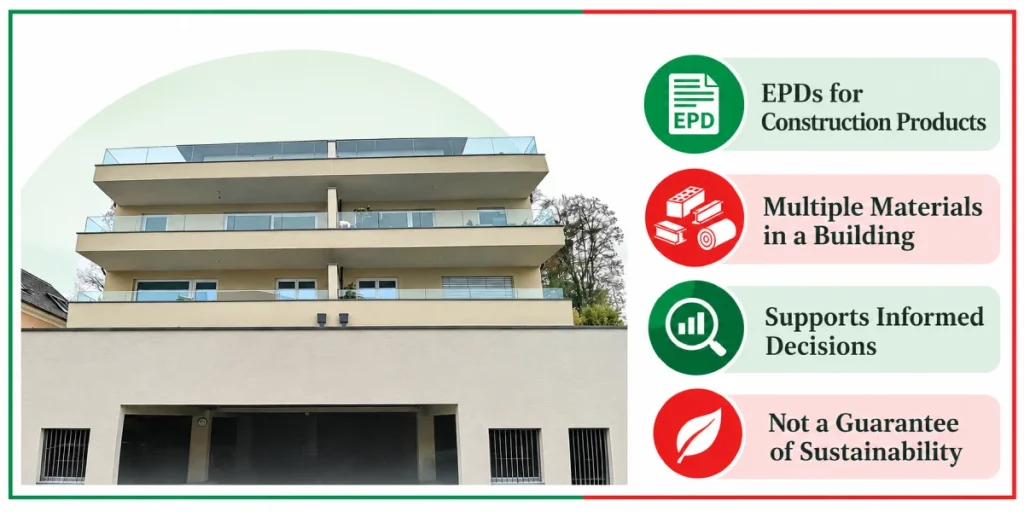
A building envelope, for example, may contain concrete, steel, aluminium, insulation, membranes, glazing and finishing materials. Each product can contribute differently to the overall environmental profile of the building.
EPDs allow project teams to obtain product-level information that can be incorporated into a wider LCA.
This does not mean that an EPD automatically makes a product sustainable. It means that the project team has better information with which to make and justify a decision.
EPDs and Green Building Certification
EPDs can support environmental assessment and green-building certification by providing standardized product-level environmental information.
For schemes such as DGNB certification, life-cycle considerations can form an important part of the assessment process. Product-level environmental data can therefore become useful when the environmental performance of a complete building is calculated.
The exact requirements vary between certification systems and project types. An EPD should therefore be checked against the specific certification criteria rather than assumed to qualify automatically.
The same principle applies to procurement. A project may require EPDs as part of its sustainability specification even where the declaration is not universally mandatory by law.
Environmental Product Declaration vs LCA
| Aspect | Environmental Product Declaration | Life Cycle Assessment |
| Purpose | Communicate standardized environmental information | Assess environmental impacts |
| Main output | Published environmental declaration | Environmental assessment results |
| Product-specific | Usually | Can be product, system or building level |
| PCR | Typically relevant | Depends on assessment purpose |
| Verification | Common within EPD programmes | Depends on the LCA application |
| Construction use | Product-level environmental information | Can support product and whole-building assessment |
| Typical users | Manufacturers, architects, engineers, sustainability teams | LCA practitioners, engineers, researchers and sustainability teams |
The simplest distinction is that LCA is the assessment, while an EPD is a standardized declaration communicating defined environmental results.
Environmental Product Declaration Examples
A practical environmental product declaration example is a prefabricated concrete building component. The EPD can report the environmental impacts associated with producing the component and, depending on its scope, transporting, installing, using and disposing of it.
The useful information for an architect is not simply the headline GWP value. The architect should first confirm the product specification, declared unit, applicable PCR, geographical assumptions and life-cycle stages. Only then can the environmental data be incorporated into a building-level assessment.
For example, if two parapet systems are being considered, the comparison should account for the amount of material required, expected service life, installation method and technical performance not simply the environmental impact per kilogram of raw material.
| EPD Example | Information to Check |
| Concrete component | GWP, declared unit, cement composition, life-cycle modules |
| Aluminium component | Aluminium source, manufacturing route, recycled content |
| Insulation product | Thermal performance, declared unit, GWP and service life |
| Façade panel | Material composition, manufacturing, transport and end-of-life |
| Prefabricated parapet | Product specification, manufacturing, transport and installation assumptions |
How to Find an Environmental Product Declaration Database
An environmental product declaration database provides a practical way for architects, engineers and sustainability consultants to locate published product declarations.
The IBU EPD programme is particularly relevant in the German construction market. Other EPD programme operators and databases serve different countries and product categories.
However, finding an EPD is only the first step. A database search may return several declarations that appear similar but have different validity periods, product specifications, declared units or assessment boundaries.
Before using an EPD in a project, verify that the document applies to the actual product being specified and that its methodology is compatible with the project’s LCA requirements.
What to Check Before Using an EPD
First check the product name, manufacturer and product range. A declaration covering a product family may not represent every product variant equally.
Next review the declared unit, PCR, geographical scope and included life-cycle stages. These details determine what the reported numbers actually represent.
Finally, check the declaration’s validity and verification information. Environmental data should be treated as technical project information rather than copied into a specification without review.
Is an Environmental Product Declaration Mandatory?
An EPD is not universally mandatory for every construction product or building project. Whether it is required depends on applicable regulations, procurement requirements, project specifications and sustainability-certification objectives.
A developer may voluntarily request EPDs from suppliers because the project has an embodied-carbon target. A public procurement process may also include environmental documentation requirements.
This distinction is important for manufacturers. An EPD can be commercially valuable even where legislation does not require one, because architects and contractors increasingly need verified environmental information during product selection.
Project teams should always check the current requirements applicable to the specific country, building programme and certification system.
Benefits of Environmental Product Declarations
The principal benefit of environmental product declarations is transparent, structured environmental information.
Instead of relying on terms such as “green,” “eco-friendly” or “low carbon,” an EPD provides quantified indicators generated according to defined rules. This makes the information much more useful to professional design teams.
EPDs can also improve communication between manufacturers and construction professionals. Designers can request product-level data, LCA practitioners can incorporate it into calculations, and manufacturers can identify environmental hotspots within their production processes.
| Benefit | Practical Application |
| Environmental transparency | Supports evidence-based product evaluation |
| Product data | Provides information for building LCA |
| Embodied-carbon assessment | Supports GWP calculations |
| Procurement | Helps establish environmental requirements |
| Certification | Can support relevant building assessments |
| Product development | Helps manufacturers identify improvement opportunities |
| Communication | Replaces vague claims with structured information |
Environmental Product Declarations and Prefabricated Construction
EPDs are increasingly relevant to prefabricated construction, where building components are manufactured under controlled factory conditions and transported to the construction site.
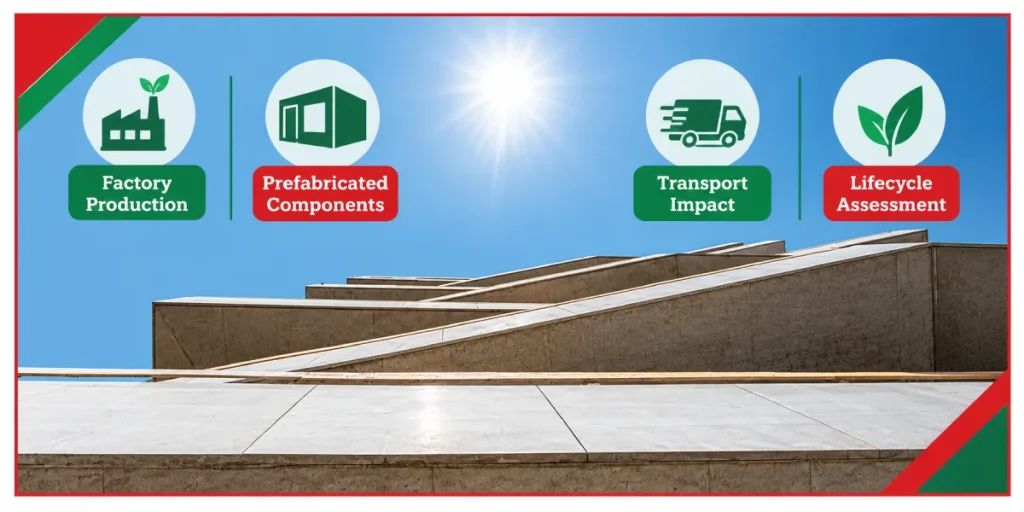
Factory production can improve dimensional consistency, quality control and manufacturing efficiency. It can also reduce the amount of fabrication required on site. However, these advantages should not automatically be interpreted as proof of lower environmental impact.
Transport distance, component weight, manufacturing energy, material quantities and installation requirements can all influence the environmental result.
For this reason, an EPD provides useful product-level information while the project team still needs to evaluate the complete construction system.
EPDs and Off-Site Manufacturing
Off-site construction changes where much of the work takes place, but it does not eliminate environmental impacts.
A prefabricated component may require additional transport compared with materials manufactured close to the construction site. Conversely, factory production may improve material efficiency and reduce waste or site operations.
The correct question is therefore not simply whether prefabrication is “green.” The question is how the specific product performs over its defined life cycle and how that performance compares with technically equivalent alternatives.
Real Construction Examples
How are Environmental Product Declarations (EPDs) used in real construction projects? The following examples show how architects and developers use EPD data to assess prefabricated components, compare environmental impacts, and make informed material choices for residential and commercial buildings.
Residential Building Example
Consider a five-storey residential building using prefabricated parapet components around several flat-roof areas.
The design team could obtain EPD data for the selected parapet system and incorporate the relevant environmental information into the building LCA. The assessment should consider the actual quantity installed rather than relying on a generic material comparison.
The team should also examine durability, installation, waterproofing interfaces and maintenance because a lower initial environmental impact is not useful if the component requires premature replacement.
Commercial Building Example
Consider a commercial building with approximately 1,500 m² of façade and roof-edge construction.
Several suppliers may offer technically comparable systems. EPDs allow the sustainability team to compare environmental data alongside cost, fire performance, durability, installation time and architectural requirements.
The best-performing product is not necessarily the one with the lowest single GWP figure. The decision should consider the complete technical and environmental requirements of the building.
Prefabricated Envelope Example
A third example is a factory-manufactured building-envelope component installed on a large residential development.
Here, the EPD can provide product-level environmental data while the project team separately evaluates transport and site logistics. Factory production may reduce site labour and weather exposure, but these benefits should be assessed within the overall project methodology.
How EPDs Affect Product Selection
An EPD should be considered alongside conventional engineering criteria rather than replacing them.
A façade panel, parapet or structural element still needs to satisfy requirements for structural performance, fire resistance, durability, weather protection, thermal performance and maintenance.
The environmental assessment becomes another decision layer.
| Decision Factor | Question |
| Environmental impact | What does the EPD report? |
| GWP | What is the reported climate-change impact? |
| Durability | How long is the expected service life? |
| Construction | How difficult is installation? |
| Labour | How much site labour is required? |
| Maintenance | What maintenance or replacement is expected? |
| Cost | What is the initial and lifecycle cost? |
| Performance | Does the product meet project requirements? |
Overtec and Environmental Product Performance
For building-envelope products, environmental performance needs to be considered together with installation, durability and construction efficiency.
Overtec’s prefabricated approach uses factory production and controlled manufacturing rather than relying entirely on conventional site-built parapet construction. This can support faster installation, better quality consistency and greater construction predictability.
The approach can also reduce site labour and dependence on highly skilled labour for repetitive construction activities. Factory precision can improve dimensional consistency, while a coordinated prefabricated component can simplify interfaces between the parapet, waterproofing and other roof-edge elements.
Overtec states a potential up to 67% reduction in CO₂ emissions. Where the system is used as a slim-profile parapet or balcony-edge solution, its reduced thickness can also create more usable balcony or terrace space, depending on the project design.
Other potential advantages include reduced weather dependency, reduced construction risk and improved lifecycle performance. Better integration of waterproofing details and reduced thermal-bridge risk can also be valuable when the component is designed as part of the complete building-envelope assembly.
These claims should, however, be evaluated against the specific project configuration and appropriate environmental documentation. An EPD or project-specific LCA provides a stronger basis for quantified environmental comparison than a generic sustainability statement.
Architect and Sustainability Checklist
| Check | Question |
| Product | Is the EPD applicable to the exact product? |
| Standard | Which standards govern the declaration? |
| PCR | Are the applicable Product Category Rules identified? |
| Unit | What is the declared unit? |
| GWP | What is the reported Global Warming Potential? |
| Life cycle | Which life-cycle stages are included? |
| Verification | Has the declaration undergone required verification? |
| Validity | Is the EPD current? |
| Comparison | Are competing EPDs methodologically comparable? |
| Building LCA | Can the data be incorporated into the project’s assessment? |
Frequently Asked Questions About Environmental Product Declarations
Environmental Product Declarations (EPDs) raise important questions about environmental performance, standards, and sustainable construction. The following FAQs explain what an EPD is, how it works, whether it is mandatory, and how it helps professionals evaluate construction products.
An environmental product declaration is a standardized document that communicates quantified environmental information about a product using defined life-cycle assessment rules.
EPD stands for Environmental Product Declaration.
They provide product-level environmental information that can support material selection, procurement, LCA calculations and building sustainability assessments.
An LCA is the assessment of environmental impacts. An EPD is a standardized declaration communicating defined environmental results from that assessment.
It can contain product information, declared unit, PCR, environmental impact indicators, life-cycle stages, assumptions, methodology and verification information.
Not universally. Requirements depend on applicable regulations, procurement specifications and project or certification requirements.
Only when the products, declared or functional units, PCR, system boundaries, life-cycle stages and assumptions are sufficiently comparable.
GWP is an environmental indicator representing potential contribution to climate change, generally expressed using carbon-dioxide-equivalent units.
A declared unit is the reference quantity used for reporting environmental results for a product.
EPDs can provide product-level environmental data that may be used in building-level environmental assessments and relevant certification calculations.
EPDs can be accessed through recognized EPD programme operators and databases, including programmes such as the IBU EPD programme.
No. An EPD reports environmental performance; it does not automatically mean that a product is environmentally superior or universally sustainable.
Conclusion
An environmental product declaration provides a structured method for communicating quantified environmental information about construction products.
Its value lies in transparency. Rather than relying on broad sustainability claims, architects and engineers can examine defined environmental indicators, declared units, life-cycle stages, assumptions and verification information.
EPDs are particularly useful when environmental product data must be incorporated into a wider building LCA, embodied-carbon assessment or sustainability certification process. They should nevertheless be interpreted carefully because two declarations are not automatically comparable simply because they describe similar products.
For manufacturers, architects and developers, the direction of construction is increasingly clear: environmental performance needs to be supported by measurable information. EPDs provide one of the important tools for making that information available and usable.