Skip to content



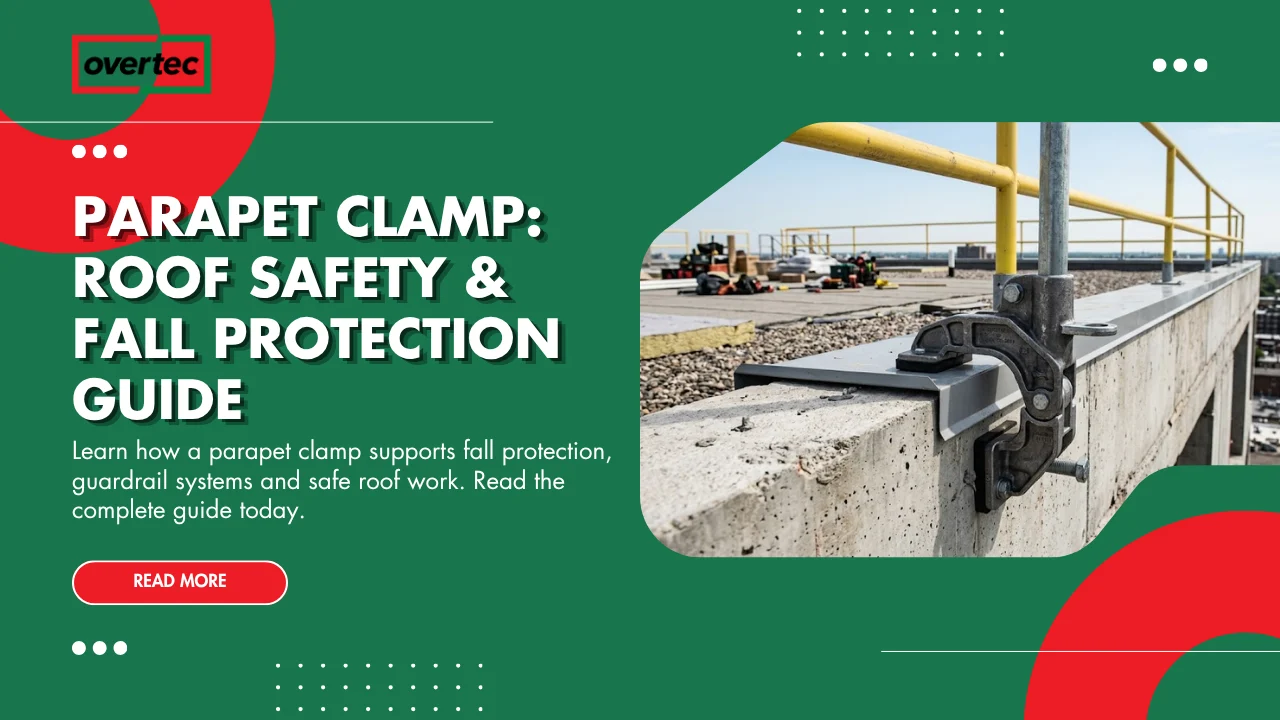
Working safely at roof level requires more than personal protective equipment. Every maintenance activity, façade inspection, suspended platform installation or rooftop construction project depends on secure anchorage and reliable edge protection. One of the most versatile components used in these situations is the parapet clamp.
Unlike permanent structural guardrails, parapet clamps are designed to grip the parapet wall without permanently altering the building. Depending on the application, they can support temporary guardrails, suspended platforms, lifeline systems, ladder stabilizers, tie-off anchors or other fall protection equipment. Their adaptability makes them widely used during construction, maintenance, façade cleaning and roofing operations.
However, selecting the correct parapet clamp requires careful engineering. The clamp must match the parapet thickness, structural capacity, expected loads and intended application. A clamp designed for temporary guardrails is not necessarily suitable for suspended platforms or fall arrest systems. Improper selection can compromise worker safety and damage the building envelope.
This guide explains how parapet clamps work, the different types available, structural considerations, installation methods, OSHA-related safety concepts, common applications, design details and modern prefabricated roof edge solutions that reduce risk while improving construction quality.
Quick Answer
| Topic | Quick Answer |
| What is a parapet clamp? | A mechanical device that securely attaches safety equipment or temporary structures to a parapet wall. |
| Main purpose | Fall protection, guardrails, suspended access and maintenance safety. |
| Permanent or temporary? | Most are temporary, but permanent engineered systems also exist. |
| Common applications | Roof maintenance, façade work, suspended platforms, temporary guardrails and lifeline anchorage. |
| Roof penetration required? | Many clamp systems avoid roof penetrations. |
| Typical materials | Aluminum, galvanized steel and structural steel. |
What Is a Parapet Clamp?
A parapet clamp is a mechanical attachment device that grips a roof parapet and provides a secure connection point for safety systems or temporary equipment. Instead of drilling directly into the roof deck or façade, the clamp transfers loads through the parapet structure.
Modern clamp systems are designed to distribute loads over a larger contact area, reducing localized stress while protecting the building from unnecessary damage. They are available in multiple sizes to accommodate different parapet widths and construction materials.
Parapet clamps are commonly used for temporary edge protection during construction, but they are also employed in building maintenance, façade access, suspended platforms and permanent roof safety systems.
Why Parapet Clamps Matter
Roof work often changes throughout the building lifecycle. HVAC servicing, waterproofing repairs, window cleaning, façade inspections and solar panel maintenance all require safe access to roof edges.
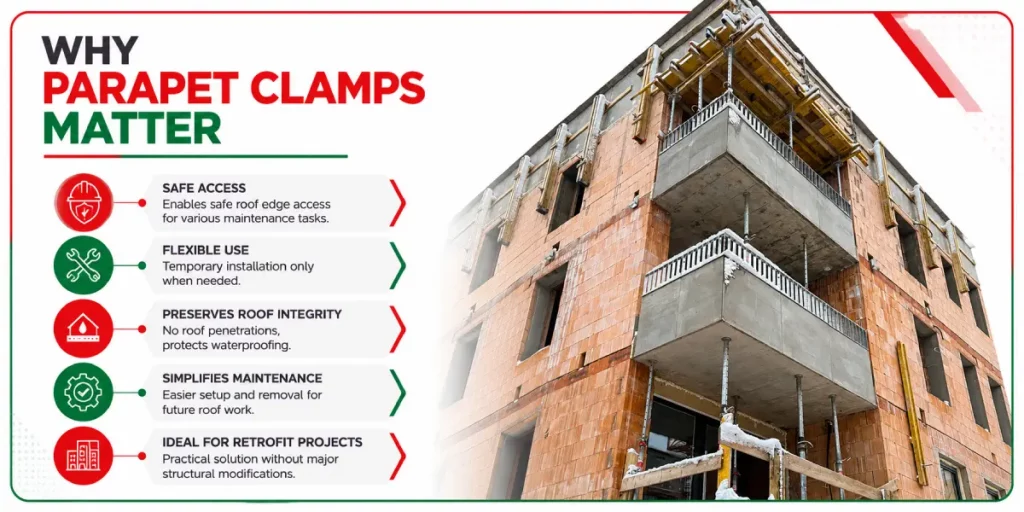
Installing permanent anchors for every possible activity is not always practical. Parapet clamps offer flexibility by allowing temporary safety equipment to be installed only when required.
They also reduce the need for roof penetrations, helping preserve waterproofing while simplifying future maintenance. In many retrofit projects, clamp systems provide a practical solution where new structural anchors would otherwise require extensive modifications.
Functions of a Parapet Clamp
Fall Protection
One of the primary purposes of a parapet clamp is supporting fall protection systems.
Depending on the design, a clamp may serve as an attachment point for temporary guardrails, horizontal lifelines or personal fall arrest systems. Properly engineered clamps help create safer work environments for roofing contractors, maintenance crews and façade specialists.
The suitability of a clamp for fall protection depends on its certified load capacity and intended application. A clamp should never be used beyond its specified design purpose.
Guardrail Support
Many clamp systems are designed specifically for temporary guardrails.
Instead of permanently installing posts into the roof slab, guardrail posts fit into clamp assemblies secured to the parapet wall. This creates effective temporary guardrail systems while avoiding unnecessary roof penetrations.
Such systems are widely used during new construction and roof refurbishment projects where temporary perimeter protection is required.
Suspended Platform Support
Certain heavy-duty parapet clamps are engineered to support suspended working platforms used for façade maintenance or window cleaning.
These clamps transfer significant loads into the parapet structure and therefore require detailed engineering evaluation before installation. They differ substantially from light-duty guardrail clamps and should never be substituted without proper design verification.
Maintenance and Access
Parapet clamps also improve access for routine building maintenance.
They can support temporary ladders, cable systems or maintenance equipment without permanently altering the building envelope, making them valuable for facility management teams responsible for long-term roof maintenance.
Types of Parapet Clamps
| Clamp Type | Typical Application | Key Advantage |
| Guardrail clamp | Temporary edge protection | Fast installation |
| Tie-off clamp | Personal fall arrest | Secure anchorage |
| Suspended platform clamp | Façade maintenance | Supports heavy loads |
| Ladder clamp | Safe ladder access | Improved stability |
| Roof stanchion clamp | Temporary guardrails | Flexible positioning |
| Window cleaning clamp | Rope access systems | Non-permanent installation |
Each clamp type is engineered for a specific purpose and should only be used within its certified load limits.
Common Applications
Parapet clamps are used across many building types.
Typical applications include:
- Commercial office buildings
- Hospitals
- Warehouses
- Industrial plants
- Hotels
- Apartment buildings
- Shopping centres
- Airports
- Data centres
- Educational facilities
They are particularly valuable where rooftop equipment requires regular maintenance but permanent safety infrastructure is impractical or unnecessary, especially on buildings with a flat roof parapet.
Materials Used
| Material | Advantages |
| Aluminum | Lightweight, corrosion resistant |
| Galvanized steel | High strength and economical |
| Stainless steel | Excellent corrosion resistance |
| Structural steel | Suitable for heavy-duty applications |
Material selection depends on environmental exposure, design loads and expected service life.
Parapet Clamp vs Permanent Anchors
| Feature | Parapet Clamp | Permanent Anchor |
| Installation | Temporary | Permanent |
| Roof penetration | Usually avoided | Often required |
| Flexibility | High | Limited |
| Reusability | Excellent | Fixed location |
| Best use | Temporary maintenance | Frequent access areas |
Choosing between the two depends on building operation, maintenance frequency and long-term safety strategy.
Design Considerations
Selecting the correct parapet clamp involves more than choosing a compatible wall width.
Engineers evaluate:
- Structural capacity of the parapet
- Wall thickness
- Concrete or masonry strength
- Wind loading
- Dynamic loading
- Equipment weight
- Intended use
- Safety factors
- Access frequency
- Inspection requirements
These factors determine whether a clamp is suitable for guardrails, suspended platforms or fall arrest applications.
Structural Design Principles
A parapet clamp transfers loads into the parapet wall.
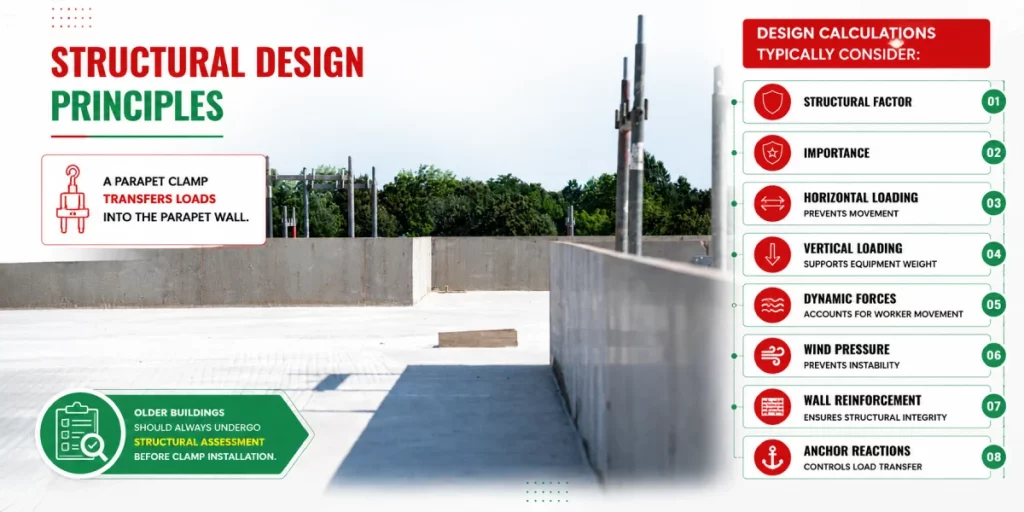
Design calculations typically consider:
| Structural Factor | Importance |
| Horizontal loading | Prevents movement |
| Vertical loading | Supports equipment weight |
| Dynamic forces | Accounts for worker movement |
| Wind pressure | Prevents instability |
| Wall reinforcement | Ensures structural integrity |
| Anchor reactions | Controls load transfer |
Older buildings should always undergo structural assessment before clamp installation.
Typical Parapet Clamp Detail
A standard parapet clamp assembly may include:
| Component | Function |
| Clamp body | Main structural element |
| Adjustable jaws | Grip parapet wall |
| Protective pads | Prevent surface damage |
| Locking mechanism | Secure attachment |
| Guardrail socket | Supports rail posts |
| Anchor point | Fall protection connection |
| Load transfer plate | Distributes forces |
Correct detailing ensures both worker safety and building protection.
Roof Waterproofing Considerations
Although many parapet clamps avoid roof penetrations, they still interact with the building envelope.
Designers should verify:
- Membrane protection
- Flashing continuity
- Drainage paths
- Thermal movement
- Corrosion compatibility
- Inspection access
Proper coordination prevents damage during installation and removal.
Real Construction Example: Commercial Office Building
A modern commercial office building uses parapet clamps during both construction and long-term maintenance.
During construction, temporary parapet clamp guardrail systems provide continuous roof edge protection without penetrating the waterproofing membrane. Once construction is complete, the temporary guardrails are removed.
Later, during the building’s operational life, maintenance contractors use certified parapet clamp anchor points when servicing rooftop HVAC equipment, cleaning façade glazing and inspecting drainage systems.
Because the clamps are reusable, the building owner avoids installing numerous permanent anchors while still maintaining a safe working environment.
Real Construction Example: Window Cleaning and Façade Maintenance
High-rise buildings frequently require suspended access equipment for façade cleaning.
In this example, engineers specify heavy-duty window cleaning parapet clamps designed for suspended platforms.
The clamp system is engineered specifically for:
- Suspended working platforms
- Rope access systems
- Window washing equipment
- Temporary façade maintenance
Each clamp transfers loads into the structural parapet while minimizing damage to the waterproofing and architectural finishes.
Because suspended platform loads are substantially higher than guardrail loads, only clamps specifically certified for this purpose should be used.
Real Construction Example: Industrial Roof Maintenance
A manufacturing facility with extensive rooftop mechanical equipment requires weekly maintenance.
Instead of installing permanent guardrails around every service route, engineers specify a reusable parapet clamp fall protection system.
Maintenance personnel install temporary guardrails only where work is being performed.
This approach:
- Reduces permanent visual impact
- Preserves architectural appearance
- Minimizes installation cost
- Allows flexible maintenance planning
- Protects roof waterproofing
Construction Details
Proper parapet clamp installation depends on more than simply tightening the clamp onto the wall. The engineer must evaluate parapet construction details, including wall thickness, concrete or masonry strength, surface condition, waterproofing, existing flashing, roof edge geometry, and design loads.
The engineer must evaluate:
- Parapet construction
- Wall thickness
- Concrete or masonry strength
- Surface condition
- Waterproofing
- Existing flashing
- Roof edge geometry
- Design loads
Typical clamp installations include:
| Component | Function |
| Structural parapet | Primary load-bearing element |
| Clamp body | Transfers applied loads |
| Adjustable jaws | Secure attachment |
| Protective pads | Prevent wall damage |
| Guardrail socket | Supports temporary rails |
| Anchor eye | Tie-off connection |
| Locking mechanism | Prevents accidental movement |
Proper installation ensures safe load transfer without damaging the building envelope.
OSHA and Roof Safety Considerations
Parapet clamps are frequently associated with OSHA-regulated fall protection activities.
Their use may include:
- Temporary guardrails
- Personal fall arrest systems
- Horizontal lifelines
- Suspended platforms
- Roof maintenance
- Window cleaning
However, OSHA compliance depends on the complete safety system—not simply the clamp itself.
Designers should evaluate:
- Load ratings
- Compatible equipment
- Structural support
- Worker training
- Inspection procedures
- Manufacturer instructions
Every project should comply with the regulations applicable to its jurisdiction. This article provides educational information rather than project-specific compliance advice.
Design Considerations
Structural Capacity
Every parapet wall has a finite structural capacity.
Before installing any parapet wall clamp, engineers should verify:
- Wall reinforcement
- Material strength
- Wall thickness
- Existing damage
- Connection capacity
An inadequately designed parapet may not safely support clamp loads.
Waterproofing Protection
One advantage of clamp systems is that many avoid penetrating the roof membrane.
Even so, installation should ensure that:
- Waterproofing remains intact
- Flashings are not damaged
- Drainage paths remain open
- Membranes are protected against abrasion
Protecting the building envelope is as important as protecting workers.
Load Distribution
High localized forces can damage parapets.
Modern clamp systems use wider bearing plates and engineered contact surfaces to distribute loads more evenly.
Proper load distribution reduces:
- Concrete crushing
- Masonry cracking
- Surface damage
- Local deformation
Inspection and Maintenance
Clamp systems require routine inspection before every use.
Typical inspection items include:
- Bent components
- Cracks
- Corrosion
- Damaged threads
- Worn protective pads
- Loose fasteners
- Missing locking pins
Damaged clamps should be removed from service immediately.
Common Mistakes
| Mistake | Consequence | Recommended Solution |
| Using the wrong clamp type | Equipment failure | Match clamp to application |
| Ignoring wall capacity | Structural damage | Verify engineering capacity |
| Over-tightening clamps | Surface damage | Follow manufacturer torque recommendations |
| Using guardrail clamps for suspended platforms | Serious safety risk | Use certified platform clamps only |
| Damaging waterproofing | Roof leaks | Protect membrane during installation |
| Skipping inspections | Hidden defects | Inspect before every use |
Most failures occur because clamps are used outside their intended application.
Cost Considerations
The cost of a parapet clamp system depends on:
- Type of clamp
- Load rating
- Material
- Certification
- Adjustability
- Corrosion protection
- Intended application
- Number of reusable cycles
Rather than considering purchase price alone, owners should evaluate:
- Service life
- Maintenance
- Inspection costs
- Equipment versatility
- Worker productivity
- Overall lifecycle value
Reusable systems often provide lower long-term costs for facilities requiring regular roof maintenance.
Traditional Anchors vs Modern Clamp Systems
| Feature | Permanent Anchors | Modern Clamp Systems |
| Installation | Permanent | Temporary or reusable |
| Roof penetrations | Usually required | Often avoided |
| Site flexibility | Limited | Excellent |
| Reusability | None | High |
| Waterproofing impact | Greater | Lower |
| Maintenance adaptability | Moderate | High |
| Initial investment | Moderate | Moderate |
| Lifecycle flexibility | Lower | Higher |
Modern Roof Edge Safety Solutions with Overtec
Modern roof edge design increasingly integrates safety, waterproofing and architectural detailing into coordinated building-envelope systems.
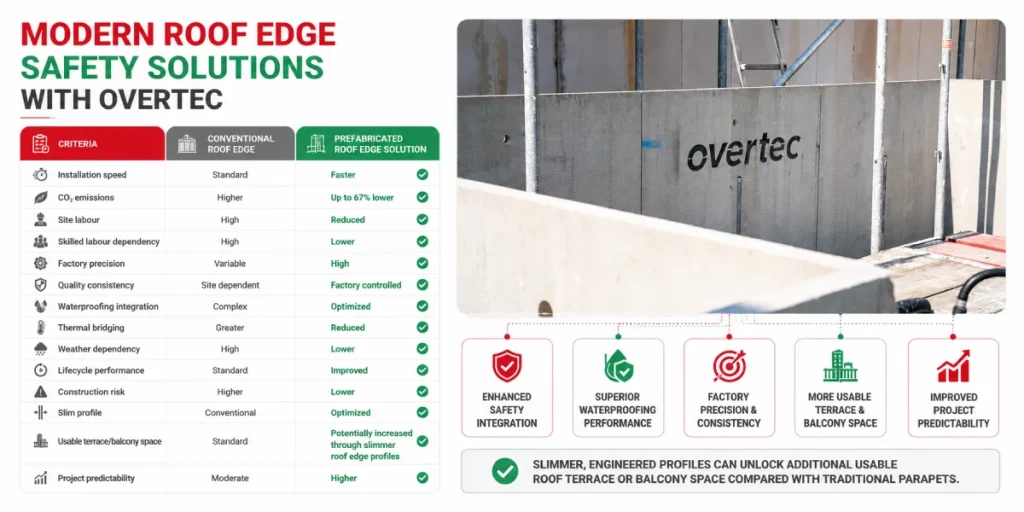
Rather than relying solely on site-built components, prefabricated roof edge assemblies improve consistency and simplify future installation of compatible safety equipment.
| Criteria | Conventional Roof Edge | Prefabricated Roof Edge Solution |
| Installation speed | Standard | Faster |
| CO₂ emissions | Higher | Up to 67% lower |
| Site labour | High | Reduced |
| Skilled labour dependency | High | Lower |
| Factory precision | Variable | High |
| Quality consistency | Site dependent | Factory controlled |
| Waterproofing integration | Complex | Optimized |
| Thermal bridging | Greater | Reduced |
| Weather dependency | High | Lower |
| Lifecycle performance | Standard | Improved |
| Construction risk | Higher | Lower |
| Slim profile | Conventional | Optimized |
| Usable terrace/balcony space | Standard | Potentially increased through slimmer roof edge profiles |
| Project predictability | Moderate | Higher |
Because prefabricated parapet systems can be manufactured with slimmer, engineered profiles, projects may gain additional usable roof terrace or balcony space compared with traditional site-built parapet assemblies.
Architect Checklist
| Design Review | ✓ |
| Clamp application identified | ✓ |
| Structural capacity verified | ✓ |
| Wall thickness confirmed | ✓ |
| Waterproofing protected | ✓ |
| Compatible safety equipment selected | ✓ |
| Load calculations completed | ✓ |
| Inspection procedures documented | ✓ |
| Maintenance access reviewed | ✓ |
| Roof drainage maintained | ✓ |
| Installation details completed | ✓ |
Construction & Inspection Checklist
| Inspection Item | Purpose |
| Inspect clamp body | Structural integrity |
| Verify locking mechanism | Safe attachment |
| Check protective pads | Prevent wall damage |
| Confirm load rating | Correct application |
| Inspect corrosion | Long-term durability |
| Verify compatibility | System safety |
| Check documentation | Regulatory compliance |
Frequently Asked Questions
A parapet clamp is a mechanical attachment device used to secure temporary or permanent safety equipment to a parapet wall without necessarily penetrating the roof structure.
Applications include temporary guardrails, fall protection systems, suspended platforms, rope access, ladder stabilization and maintenance work.
Most are temporary and reusable, although permanent engineered systems are also available.
Yes, provided they are specifically designed and certified for guardrail applications.
No. Suspended platform clamps are engineered for much higher loads and should never be replaced with standard guardrail clamps.
Properly designed clamp systems usually minimize roof penetrations and help preserve waterproofing, although careful installation is still essential.
Aluminum, galvanized steel, stainless steel and structural steel are the most common materials.
Yes. Every clamp should be inspected before use for damage, corrosion, deformation and proper operation.
Most temporary clamp systems are specifically designed for repeated use when properly maintained.
They improve installation speed, factory quality, waterproofing coordination, project predictability, reduce site labour and dependence on skilled labour, lower construction risk, reduce thermal bridging and may increase usable roof or terrace space through slimmer parapet profiles.
Conclusion
A parapet clamp is one of the most versatile components used in roof safety, enabling secure attachment of guardrails, fall protection systems, suspended platforms and maintenance equipment without extensive permanent modifications to the building. However, its effectiveness depends on selecting the correct clamp for the intended application and verifying the structural capacity of the parapet.
Successful installations require coordination between structural engineering, waterproofing, roof access planning and ongoing inspection. As roof edge construction evolves, prefabricated parapet systems provide additional benefits through faster installation, factory-controlled quality, improved waterproofing integration, reduced thermal bridging, lower construction risk, reduced dependence on skilled labour, up to 67% lower CO₂ emissions, better project predictability and slimmer profiles that can increase usable terrace or rooftop space where applicable.